


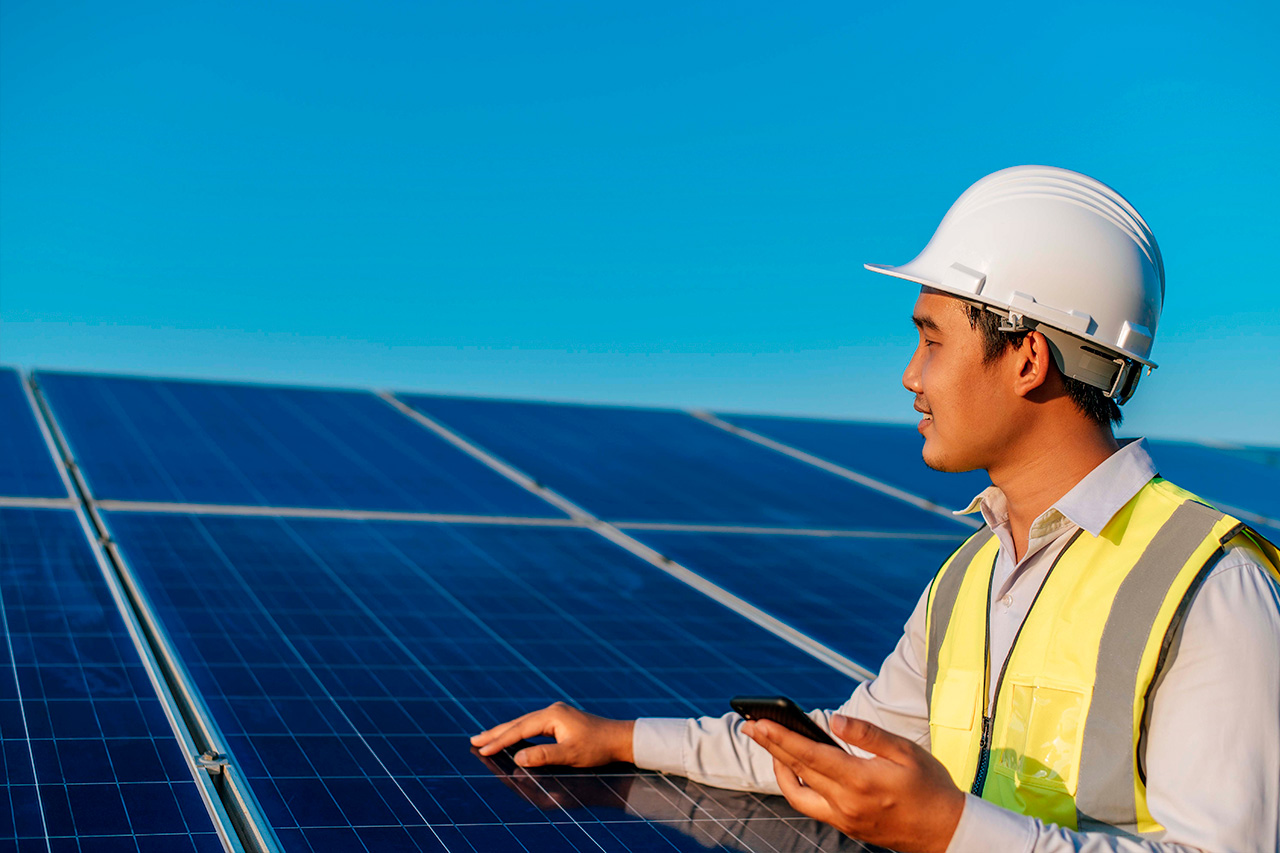
The path towards Indonesia’s energy transition is finally showing a sign of progress. Last month, the Indonesian President Prabowo Subianto officially launched a solar power program with a target capacity of 100 GWp. This was marked by a groundbreaking ceremony in Gilimanuk, Jembrana Regency, Bali. The launch of the Jembrana solar power plant took place simultaneously with three other solar plant sites, with the plan to build an additional 14 solar power plants in Bali, Java, and Sumatra.
The ceremony took place in Bali, chosen to become an integral landmark in the process due to its ‘Bali Net Zero 2045’ commitment. The commitment is aimed at reducing dependence on fossil fuels and energy supplies from outside the island.
So, how far along is the government’s commitment? How does this vision translate into an actionable commitment? Keep on reading to see what impact investors can expect from this energy transition initiative.
Foreign investors in Indonesia’s renewables are all too familiar with regulatory delays, shifting local content requirements (TKDN), and lengthy power purchase agreements with the state-owned utility PT PLN. The Jembrana initiative represents a direct effort to break through existing systemic bottlenecks.
- Direct presidential backing. By selecting Jembrana to kick off the national 100 GWpmandate, the central government has aligned the Ministry of Energy and Mineral Resources (ESDM), sovereign wealth manager Danantara, and state utility PLN behind accelerated project execution.
- De-risking land acquisition. A common challenge for utility-scale solar projects in Southeast Asia is land sourcing. In Bali, government agencies secured over 1,000 hectares of state-owned land under clear administrative recommendations. This significantly lowers capital expenditure (CapEx) volatility and timeline risks during early development.
- Replacing costly diesel (PLTD). The Jembrana plant is designed to phase out diesel generation on the island, saving roughly 600 million liters of imported fuel annually. The fiscal incentive to replace expensive imported fuel with solar guarantees strong political momentum for long-term power off-take reliability
Unlocking Large-Scale Utility Solar and Storage Opportunities
The scale of Jembrana solar power plant underscores a broader market reality: pure solar generation is no longer sufficient; grid-scale energy storage is essential.
A simulation by The Institute for Essential Reform (IESR), an independent think tank, shows that the potential for rooftop solar power is as high as 25.9 MWp for 5-star hotels just in the Nusa Dua and Kuta areas. The potential for rooftop solar power for public buildings and facilities in Bali, based on the simulation, is also quite high, reaching 15.6 MWp.
This highlights the significant potential of industries supporting renewable energy, particularly solar energy. In the solar panel supply chain, for instance, the industries include a variety of sectors, ranging from raw material extraction to downstream installation and circular end-of-life management.
Indonesia has the potential to become a regional manufacturing hub for solar PV components. Several solar cell and module manufacturers have started to set up production facilities in Indonesia, a positive sign that Indonesia is competitive in the global market.
Project Economics and Financing Structure
The nationwide 100 GWp program will require structured blended finance, international debt syndication, and private equity participation. The financial architecture offers attractive characteristics for institutional capital. As PLN leads project execution alongside PLN Indonesia Power, future IPP framework auctions are expected to feature updated PPA structures designed to improve international bankability.
The 100 GWp buildout is projected to offset 140.16 million tons of CO2 emissions. This creates opportunities for international green bond issuance, multilateral climate financing (such as the Just Energy Transition Partnership/JETP), and voluntary carbon credits.
Investing in Jembrana Solar Power Plant: Strategic Considerations for Impact Investors
The 100GWp success isn’t measured by how many raw materials are reserved in the country, or how ambitious the groundbreakings are. Rather, it is measured by looking at the nation’s capacity at the moment: how many gigawatts of solar power we can build, how we ensure we launch a robust network, and the reliability of power generation. These are the guiding questions for decision-makers.
As for you impact investors, you may want to check these 6 priority steps, proposed by IESR, to ensure program implementation can be meaningfully achieved by the Indonesian government, and decide on your next step.
- Legal certainty. Direct political backing goes beyond speeches and ceremonies. It has to be translated into a Presidential Decree to form concrete legal certainty.
- An annual project pipeline up to 2029, for a clear target and roadmap for the public and potential investors.
- Expedite procurement processes to ensure competitive pricing and attract private capital.
- Ensure the electrical system is ready for solar adoption by developing and strengthening transmission and distribution networks.
- Develop a national supply chain with protective, phased, and realistic measures
- Enable multi-track implementation so the project isn’t solely dependent on PLN
Key Takeaways for Investors
While the Jembrana launch signals high-level policy momentum, foreign investors should also carefully evaluate key market parameters:
- Grid upgrades and interconnection: Integrating intermittent renewables across Indonesia’s archipelagic power grid requires substantial high-voltage transmission investments. Consortiums that integrate grid improvement solutions into their bids will navigate interconnection approvals more efficiently.
- Local Content Requirements (TKDN): To participate in upcoming project tenders, foreign OEMs and developers must establish local supply chain partnerships or form joint ventures with domestic manufacturing entities.
- Execution timeline: Commercial Operation Dates (COD) for projects within this program, including Jembrana (targeted for 2028), require precise supply chain coordination. Ensuring long-term supply agreements for PV modules and lithium/LFP battery cells early in the process will be essential to avoiding cost overruns.
The decision to invest in the energy sector in Indonesia naturally requires extensive consideration and large-scale, meticulous assessment. The Jembrana solar power plant is a major first step for Indonesia in its energy transition, and impact investors may need to look for well-resourced information on this national-scale project. The 6 priorities above could be one of your entry points for what to consider if you’re planning to invest in Indonesia.